.png)
Wrapping Your Hands Around the Internet: How we use tinkering to make the intangible tangible
Updated: Aug 12
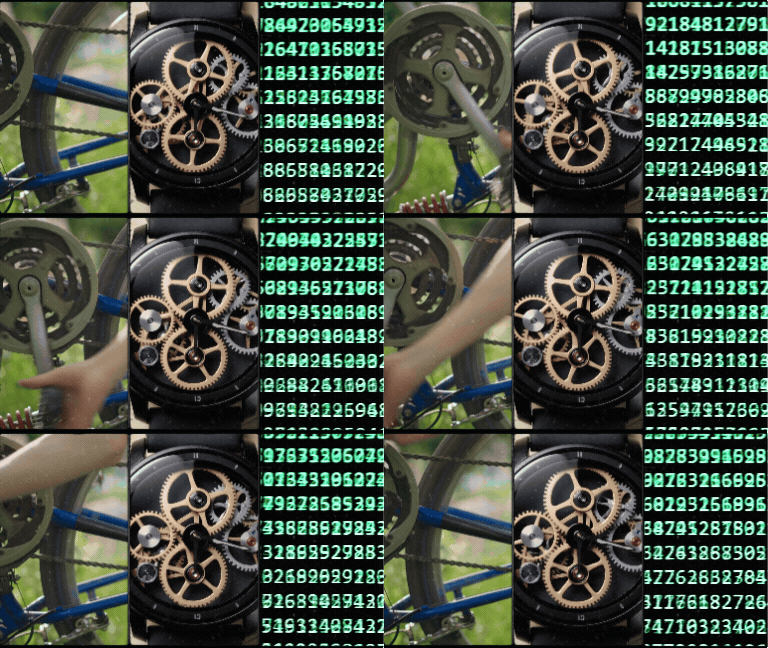
If I hold up a bicycle, spin the pedal, and show you how it moves the chain to spin the wheel, you instantly understand how the whole thing works. If I do the same with a mechanical watch, you might understand a little less than the bike, but you still grasp the cause-and-effect of the gears, the motion, and how they count the passage of time.
But if I pull back the curtain on a modern digital algorithm and show you a wall of linear, abstract code? You will be no closer to understanding its motivations, limitations, societal implications, or how it affects your own daily life than you were before.
Technology has become incredibly complex and entirely opaque. The traditional barrier to understanding it—usually requiring you to learn how to code first—makes it incredibly difficult to explore through active creating. To truly wrap our heads around these massive digital systems, we need to start with our hands. LitKit activities use physical metaphors (i.e. things we can touch that help us visualize a concept), tangible analogies (things we understand that can be compared to abstract concepts, e.g. an algorithm is like a recipe); and interactive experimentation which allows us to see for ourselves the results or action/reaction relationship of the many moving parts of an entire system.
Playing with Fictional Forks and Focus-Stealers in The Age of the Algorithm.
To understand an algorithm, we don’t look at code; we play a game.
Imagine a physical board game where every move you make is a fork in the road. If you choose to go left, the path leads you directly down a rabbit hole of online outrage. If you choose right, you are fed nothing but extreme weight-loss hacks. The game acts as a narrative sandbox where makers can safely play through the branching paths of algorithmic choices without the real-world consequences of radicalization loops or doomscrolling.
The next time you are online and your thumb hesitates over a post or lingers on a video, that physical game flashes in your memory. You suddenly realize that clicking a mouse, tapping "like," or pausing your scroll is that exact same fork in the road. You understand why you experience information silos, and why your friends or family don't see the same internet you do.
An analog experience makes the invisible system visible.
The LitKit Philosophy: Building the Physical Foundations
Every LitKit is built on this foundation: we use tactile, analog play to make abstract digital concepts tangible. By exploring the elements of the kit’s tech theme, creators build the conceptual framework they need before they ever touch the digital tools.
The ALL ABOUT GIFS Kit: Before creating digital loops, makers play with frame rates, image order, circular narratives and the physics of movement.
The ALL ABOUT AI (Artificial Intelligence) Kit: Before diving into generating images, makers explore how datasets and artificial neural networks are constructed using purely analog materials.
The ALL ABOUT AR (Augmented Reality) Kit: Teaches spatial computing concepts, the science of holographs, and how image-recognition technology works with lenses to activate digital layers.
The ALL ABOUT EMOJI Kit: Explores how the human brain processes visual information, early coding and the modern infrastructure that allows for emoji to appear in all the world’s many keyboards.
Taking these complex, layered systems and breaking them down into parts you can hold in your hand is both simple and empowering, like having the superpower to see the Matrix. It lets you look past the surface layer to understand the inner mechanics. Instead of just being trained on how to use existing technology, you gain the agency to bend, reshape, reconsider and rewrite the rules.
You don't need a computer science degree to understand the digital world. You just need the space to take it apart with your hands.

🌈⭐ More to Explore:
WATCH: 🎙️ Mitchel Resnick: Let's Teach Kids to Code? Actually, Let's Teach Them to Create - A 15-minute talk that perfectly captures why making matters more than memorizing.
READ: "STEM and the Black Box The Right to Inspect What Governs Us", By Andrew B. Raupp, the Founder of STEM.org Educational Research on "the reduction of STEM education to interaction with systems whose inner workings remain hidden, inaccessible, or treated as unnecessary to understand."
LISTEN: Life With Machines podcast, Baratunde Thurston

Comments